Somebody hands you a letter. A2 after a placement quiz, B1 on a certificate from a course you took in 2019, B2 because a recruiter asked and it felt like the safe answer. The letter is supposed to say where your Spanish stands, and on its own it says very little.
The six levels are real, they mean the same thing in every country, and they describe something specific. What gets lost between the letter and the learner is what each level looks like in an actual conversation: the moment you stall, the moment you stop translating in your head, the moment the person across from you stops speaking slowly for your benefit.
So here is the scale, level by level, described by what happens when you open your mouth. At the end: what to write on a résumé, how long each level takes, and how to find out which one is yours.
The six Spanish levels, and who decides them
The scale is the Common European Framework of Reference for Languages, published by the Council of Europe in 2001 and updated in 2020. Six levels in three pairs: A1 and A2 for a basic user, B1 and B2 for an independent user, C1 and C2 for a proficient one.
It is the same scale behind the official exams. The DELE is granted by the Instituto Cervantes on behalf of Spain's Ministry of Education, and it is offered level by level, A1 through C2. The SIELE reports on the same six. A B1 issued in Salamanca means what a B1 means in Buenos Aires.
One detail gets skipped, and it explains a lot of the confusion: the framework grades four skills separately. Reading, listening, speaking, writing. Most people have a spread of two levels across those four, and the one that matters in a conversation is the one you are worst at, not the average.
A1 and A2: getting through a transaction
At A1 you have words and set phrases. You can say your name, where you are from and what you want. Un café, por favor works, and so does asking what it costs. Then the answer comes back at full speed and you are lost, and you know you are lost.
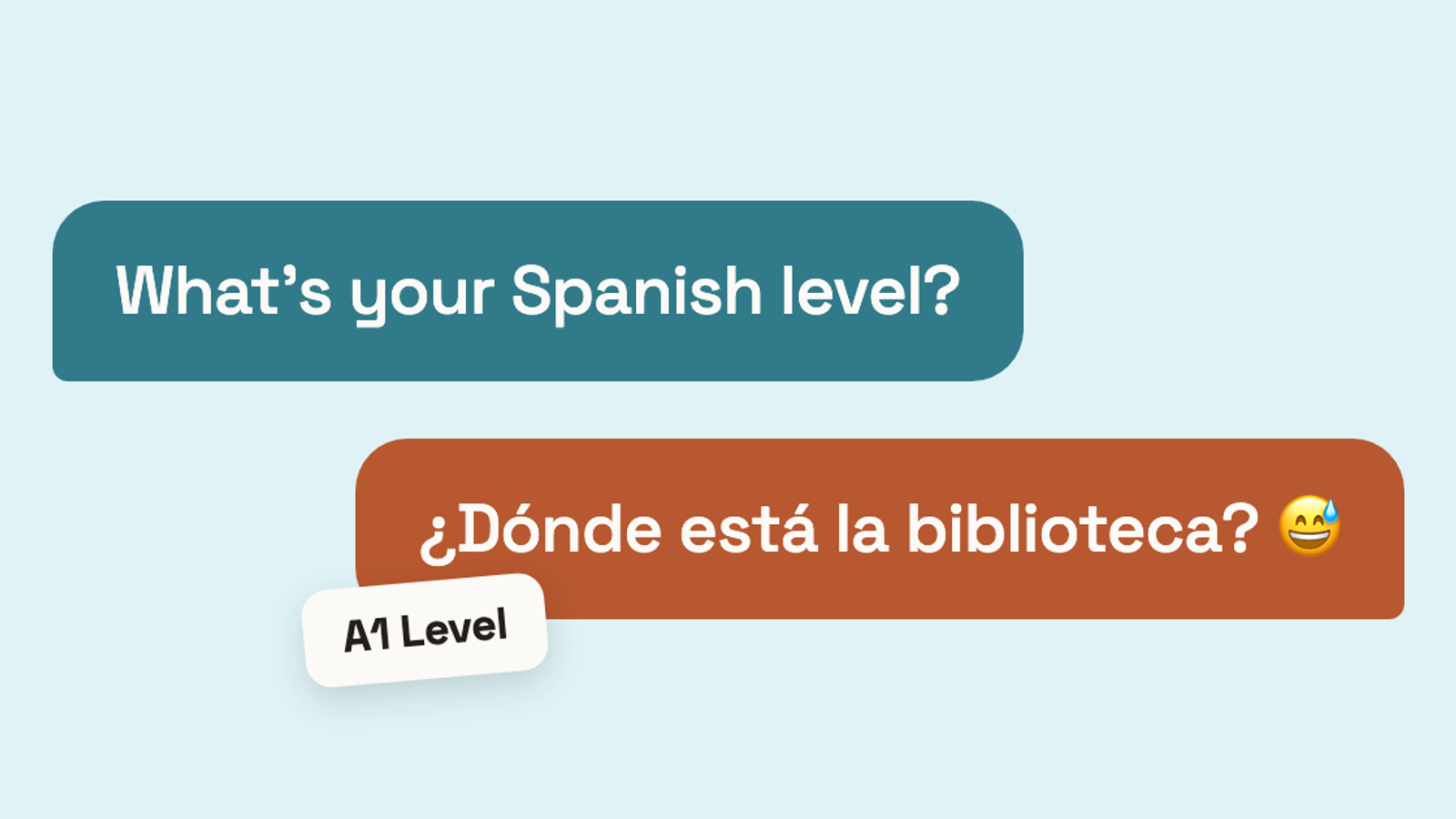
This is also where ¿Dónde está la biblioteca? lives, the one sentence half the English-speaking world still has by heart from school. Producing it on demand is A1 exactly: you stored the phrase whole rather than built the sentence. The proof arrives a second later, when somebody tells you where the library is.
At A2 the everyday transactions finish. A hotel check-in, a train ticket, a menu you can read and order from, a taxi driver who needs an address. What you cannot do yet is tell a story. Anything that happened yesterday needs a run-up, and you stall halfway through it.
The line between the two is simple: at A2 the exchange completes without the other person rescuing it.
B1: the level most people call conversational
B1 is where a conversation becomes possible with someone who is being patient with you. You can explain what you do for a living, say what you did at the weekend, ask for what you need and understand the answer you get.
You also take the long way round, constantly. You know one way to say a thing and you use it. You steer around the constructions you are not sure of, and the other person never notices, because the sentence still works. Es que… and o sea buy you the half second you need to find the rest of it.
Where B1 runs out is predictable. Three people talking at once. A phone call with no face to read. Anyone with no particular reason to slow down. Most people who describe their Spanish as conversational are somewhere in B1, and the quickest way to know is to test how fluently you speak Spanish rather than to work backwards from a course you finished years ago.
Speak Spanish for 2 minutes, free
B2: where people stop slowing down for you
Something changes at B2 and it is visible from the outside: people stop adjusting. They speak to you the way they speak to each other, at the speed they use with each other, and they stop checking that you followed.
You hold your own in a meeting. You disagree with someone and you are taken seriously. You handle a subject nobody warned you about. You still make mistakes, several a minute, and they no longer get in the way of what you meant.
B2 is what most job postings mean when they write "fluent Spanish", and it is the level most Spanish-speaking universities ask of foreign students. In the stricter sense the word points one level higher, which is why what fluent in Spanish actually means is worth reading before you put it on a résumé.
That gap is the most common shape of the problem, and it is why people who understand Spanish and still freeze when they speak are so often told they are better than they feel.
C1 and C2: past the point the scale is useful
At C1 you stop planning sentences before you say them. You keep up when three people talk over each other. You can be deliberately funny, which takes more control than being serious. When a word is missing you talk around it, and nobody hears the detour.
At C2 you hear where somebody is from. You catch the joke as it lands rather than three seconds later. You move between talking to a friend and talking to a notary without thinking about it.
Worth saying plainly: past B2 the scale stops being useful for most people. Almost nobody needs C1 for work, for travel or for friendship. The US Foreign Service Institute counts 600 to 750 class hours of Spanish to reach what it calls a professional working level, and that is already past what a normal life requires.
What to write on a résumé
The words on a résumé come from a different scale. The ILR, used by US federal agencies, runs 0 to 5: no proficiency, elementary, limited working, professional working, full professional, and native or bilingual. LinkedIn borrowed those labels, which is why they turn up on so many profiles.
Two scales, built for two purposes, and no official body publishes a conversion between them. As a rule of thumb, and nothing more than that:
- A2 is elementary proficiency
- B1 is limited working proficiency, which is the honest phrase for "conversational"
- B2 is professional working proficiency
- C1 and C2 are full professional proficiency
How long each level takes
At a few hours a week, A2 arrives in three to six months, B1 in six to twelve, and B2 somewhere between one and three years depending on your rhythm. The Foreign Service Institute's 600 to 750 hours is the professional ceiling, and it is a fraction of what most people are aiming for.
The hours are not interchangeable, which is why two people with the same total can be a year apart. An hour of conversation trains listening, vocabulary and reflexes at once; an hour of exercises trains one of the three. That is the whole of how long it takes to learn Spanish, compressed into one sentence.
How to find out which one you are
Reading a list of levels and recognising yourself is a reasonable start. It is also how people land two levels off, in both directions.
Self-assessment misses for a specific reason: you judge yourself on your best five minutes, the ones where you knew the topic and the other person was kind. Your level shows in the other five, on a subject nobody warned you about, at the speed the other person actually uses.
What settles it is speaking. Two minutes, out loud, on something you did not prepare, graded against the framework rather than against how you felt afterwards. Then the letter means something, because it comes with the thing you need to work on. After that it is a matter of putting hours on the clock, and there are worse places to start than to practise speaking Spanish for free with someone who is learning your language in return. That is what PalVivo is for.