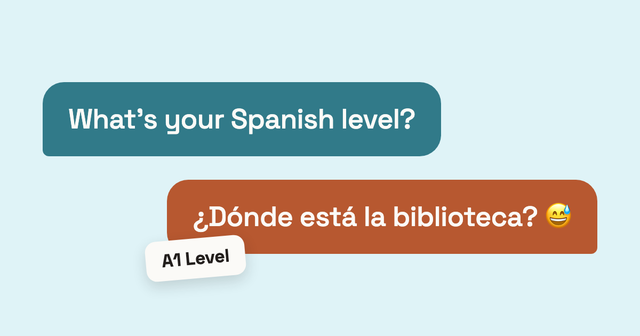
You have done the work. The streak is long, you can read a news article in Spanish, and you follow most of a series with the subtitles on. Then someone speaks to you at normal speed, and the sentence you need arrives four seconds too late.
Closing that gap is what people mean when they say they want to be fluent in Spanish. Fluency is a skill of its own, separate from how much Spanish you know, and it grows from one thing: time spent talking.
Here is what fluent actually means, which level it matches, the signs that you are getting there, and the weekly habit that gets you there without moving abroad.
What fluent in Spanish actually means
Fluent means the conversation keeps going. Mistakes included, accent included, the odd missing word included. What marks a fluent speaker is what happens at the edge of their Spanish: they reach for a word, it is not there, and they go around it without stopping.
Two words get used as if they were the same. Conversational Spanish is holding fifteen minutes on familiar ground, your job, your weekend, where you are from, with someone who adjusts to you. Fluent Spanish is holding the conversation you did not choose: the topic changes, two people talk at once, nobody slows down, and you stay in it.
Neither one requires perfect grammar. Native speakers make mistakes all the time and nobody questions their fluency. What they have is speed: the sentence arrives while it is still useful.
Which level is fluent Spanish?
The Common European Framework, the scale behind every official Spanish exam, has six levels from A1 to C2. The word fluent appears nowhere on it, which is why two people who both call themselves fluent can be a full level apart.
In practice it lands in one of two places. When a job posting asks for fluent Spanish, it usually means B2: you work in Spanish, you sit through a meeting, you disagree with someone and you are taken seriously. In the stricter sense, speaking without assembling your sentences first, on a subject you know almost nothing about, it is C1.
B2 is where fluency starts to feel real, because it is where native speakers stop slowing down for you. For most people it is the right target. If you want the whole scale, here is what each Spanish level sounds like, scene by scene.
How to tell you are getting fluent
Fluency shows up in small moments long before it shows up on a certificate. These are the ones to watch for:
- You stop translating in your head. The Spanish sentence starts without an English one underneath it.
- A missing word no longer stops you. You say la cosa para abrir latas instead of going silent over abrelatas.
- You follow native speakers at their real speed, including the ones with no reason to slow down for you.
- Your first answer comes out in Spanish, even when the question surprised you.
- Thirty minutes no longer drain you. A long conversation used to leave you exhausted. Now it is just a conversation.
- You get the joke, or at least you notice there was one.
If three or four of those are true, you are closer than you think. If none are, the reason is rarely what you know. The quickest way to find out where you stand is to check how fluently you speak today: two minutes out loud, graded on the European scale, with fluency and pace scored separately from grammar.
Speak Spanish for 2 minutes, free
What actually builds fluency
Knowledge and fluency grow from different kinds of practice. Vocabulary, grammar, apps and courses build what you know. Fluency is the speed at which you can get it out, and it only grows under one condition: someone is waiting for your answer.
That is why hours of study do not convert neatly into hours of speaking. The US Foreign Service Institute counts 600 to 750 class hours for an English speaker to reach professional working Spanish. At a few hours a week, B2 takes somewhere between one and three years, and the people at the short end are the ones who talk the most. The full breakdown is in how long it takes to learn Spanish.
Apps have their place. They are good at vocabulary and at getting you to show up every day. What they cannot do is interrupt you, change the subject or speak at full speed with a Mexican accent. Duolingo alone takes your reading much further than your speaking.
The practice that builds fluency directly is conversation with a native speaker: unscripted, regular, and long enough that you run out of prepared sentences. That last part matters most. Fluency is built in the minutes after your prepared material runs out.
Three traps that cost English speakers months
Waiting until you feel ready. Learning a bit more before speaking sounds sensible, and it works backwards: the readiness comes from speaking. People who wait for it often freeze when it is their turn to talk years later, with a large vocabulary they cannot reach in time.
Hearing only one Spanish. A teacher, a podcast host, an app voice: all clear, all at the same pace. Then you meet a Colombian, an Argentinian or a Mexican talking to a friend, and it sounds like another language. The fix is hearing several speakers early, in real conversation.
Treating Spanish as a subject. Grammar you can explain but not use, verb tables you can recite but never need at speed. English speakers start with thousands of words that look alike in both languages, and the fastest progress comes from using that head start out loud rather than studying it.
A week that moves you forward
Fluency does not need a dramatic plan. It needs a rhythm you can keep for months. A realistic week looks like this:
- Two conversations of 30 to 60 minutes with a native Spanish speaker. This is the part that does the work.
- Ten minutes of listening a day, to real speakers rather than learner material: a podcast, a YouTube channel, a series in its original Spanish.
- A few ready-made phrases for the moments you stall, like ¿cómo se dice…?, o sea or es que…. They buy you time to find the rest of the sentence, and here are more phrases to have ready when you speak.
- Five minutes after each conversation to write down the one thing you wanted to say and could not. Next time, you can.
Finding the conversations is the hard part for most people. A language exchange solves it without a teacher’s bill: you talk with a native Spanish speaker who is learning English, half the call in Spanish and half in English, so both of you get what you came for. That is what PalVivo is built around.
Fluency is built one conversation at a time
Fluent Spanish arrives the way any habit does: conversation by conversation, until the sentence comes out on time. Two conversations this week will move you further than another month of reading about it. Start by finding out where you stand.