Free language exchange
Finally get fluent in Spanish by making friends abroad.
Get matched with your ideal partner: same interests, same schedule, and you each speak the language the other is learning. Meet on video every week: you build your Spanish or French fluency while they work on their English.
- Free, no credit card
- 100% speaking practice
- Partner found automatically
- Up to 2 sessions a week
What holds you back from speaking (and how we help)
How we help
You're paired automatically with someone to practise with, based on when you're free and what you're into.
Your partner is learning English, so they get their own turn. The app switches language every 5 minutes, and when it's your turn, the call stays in the language you're learning.
Same person, same day, same time, every week. The habit builds itself, and your partner is counting on you. It's hard to let down someone who quickly becomes a friend.
Icebreaker questions pop up to help you get started and keep the conversation going for the whole call.
You're in the same boat and there to help each other. The exchange is kind from start to finish: your partner will make as many mistakes as you, and that's perfectly normal.
The solution
Someone to talk to every week, to finally speak up and feel at ease.

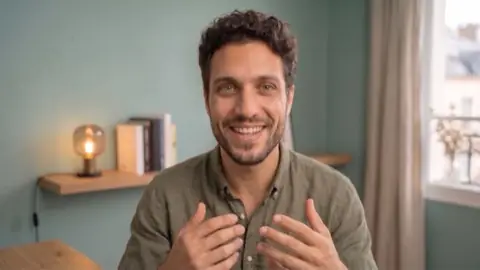
Because you both picked Travel
Para ti, ¿cuál es el lugar que hay que visitar en tu país?

¡Hola Lucía! ¿Qué tal?

¡Acabo de comprar los vuelos para ese viaje del que te hablé!
The stranger from the first call quickly becomes a friend abroad you catch up with every week. Talking week after week, you get more fluent without even noticing.
How it works
We find you the right partner
You speak English and you're learning Spanish? We connect you with someone who speaks Spanish and is learning English, based on when you're both free and what you both enjoy. In short, a match made for easy conversation.
A perfectly fair exchange
Pick a 30- or 60-minute session. The app switches language automatically every 5 minutes, so you both get exactly the same time to speak. Everyone gets something out of it!
Same time, same partner
At the end of the call, you each say privately whether you'd like to keep going. If it's mutual, next week is booked automatically. That regularity is what builds your confidence and turns practice into a habit that makes you better week after week.
Never stuck for words
Hit a blank or run out of ideas? You can count on icebreaker questions built around the interests you share, any time. Enough to get the conversation going again in a second.
Where was your last trip?
The winning recipe for becoming bilingual.
Fluency isn't a secret. It comes down to a few simple ingredients. The trouble is that most apps quietly leave out the main one. Here's the whole recipe.
The ingredients for becoming bilingual
The ingredients for becoming bilingual
Speak for real
You only learn to speak by speaking. Reading, scrolling a screen or bingeing Netflix will never loosen your tongue. Only a real conversation does.
Make it a habit
A little, often, beats a lot once. With an accountability partner waiting for you every week, you keep the appointment, and that's what turns practice into progress.
Find your accountability partner
It's the gym buddy idea: training with someone is far more motivating than going solo! Positive peer pressure turns practice from a lonely chore into a fun exchange.
Build a real friendship
Beyond the practice, a real bond forms. Once the appointment goes from “language session” to time with a friend, keeping the routine takes no effort at all. That friendship is what makes the habit stick for the long run.
Most apps keep you clicking through lessons. PalVivo gives you the push to finally speak.
Where it fits
The missing half of your language course.
Classes, textbooks and apps are perfect for the basics: vocabulary, grammar, sentence structure. But you only learn to speak by speaking. This is where you put it all into practice: real conversations with a partner, 100% free. The ideal complement to everything you're already doing.
Your course or app
The theory: words, grammar, the rules of the language.
PalVivo
The practice: speaking out loud with a partner, twice a week, for free.
The breakthrough to becoming bilingual.
The comparison
PalVivo vs other language apps.
With other apps, exchanges often stop at a few text messages. The secret to finally speaking is having someone who shows up at a set time every week. Here's how we stand out.
| PalVivo | The other apps | |
|---|---|---|
| The experience | You talk on video live with a real person. | You send written messages without ever opening your mouth. |
| The intention | Learning the language, discovering a culture and making real connections. | A “dating app” vibe (photos, swiping) with no real wish to learn. |
| Finding a partner | Automatic matching based on when you're free and what you share. Zero cold messaging. | Hours writing to strangers who almost never reply. |
| Regularity | A fixed appointment every week with a partner who's expecting you. | One nice exchange, then radio silence the week after. |
| Balance | Guaranteed 50/50 time (the screen switches languages automatically). | A lopsided exchange where one person hogs the floor or the other gets bored. |
| What you talk about | Tailored topics and prompts based on your shared passions. | It's on you to improvise, and the awkward silence sets in fast. |
| The price | 100% free, swapping as equals with people who love languages. | Sometimes free, often a subscription or a tutor at US$15–25 an hour. Why pay that much just to have a conversation? |
Become bilingual through real, regular conversations.No subscription, no hidden fees. Find the perfect partner to practise with every week.
Sign up for freeWho it's for
Made for people who want to finally start speaking.
You know the theory, not the practice
You work through lessons and quizzes on your phone, but you never get a chance to actually speak in a real conversation.
You want a real human exchange
No more facing passive exercises alone. You need a dedicated partner who's waiting for you every week for a real conversation, as equals.
You want real results
You're ready to make the language part of your everyday life. Not to rack up points, but to hold easy conversations week after week.
Go from theory to fluency
Meet real people and grow confident speaking, for free.
Sign up for freeQuestions
The things people ask first.
Yes. You get paired with people who speak the language you're learning, and you practise out loud together, up to two video sessions a week. There's no card at signup and no paid tier hiding the good part.
Most apps are things you do alone on a screen: you tap, you read, you keep a streak, but you rarely speak. PalVivo is up to two standing appointments a week with real people who are expecting you, so you actually talk out loud.
English, Français and Español at launch. You tell us the language you speak and the one you're learning, and we pair you with your mirror image. More languages open up as more people join.
It's a language exchange between two learners, not a class. There's no teacher and no lesson plan. Half the call is in each language, so you both get real practice and you both help each other.
Yes, one you talk to on video every week instead of writing to, who's learning English while you practise their language.
No. As long as you can read a little of the language you're learning, you can start. The call is half in a language you already speak, so you're never fully out of your depth.
You choose: 30 or 60 minutes, split evenly between the two languages. You can do up to two sessions a week, so it's short enough to fit a normal week and often enough to actually make progress.
After each call you rate them privately. If either of you would rather not continue, that's the end of it (no awkward conversation) and we look for someone new for next week.
You let your partner know and pick another slot together. The point is a steady rhythm, not a rule you get punished for breaking.
Yes. No trial, no card at signup, no paid tier hiding behind the good features. The whole thing is up to two video sessions a week with your partner.
A lot of them have drifted that way: profile photos, swiping, and plenty of people who are there to flirt rather than to practise. PalVivo has no swiping and no browsing of profiles. You're matched on the languages you speak and the ones you're learning, you meet on a video call at a set time, and that's the whole product.
The hard part isn't finding one conversation, it's getting a second one. What works is a standing appointment: the same person, the same slot each week, and an exchange where they need the practice as much as you do. That's exactly what PalVivo sets up, so you stop spending your evenings messaging strangers who never reply.
The blog
Tips to get more fluent
· 6 min read
How to Become Fluent in Spanish (and What Fluent Means)
Fluent means the conversation keeps going. Which level that is, the signs you are getting there, and the weekly habit that builds fluency without moving abroad.
Read the article →
· 5 min read
B2 French Level: What It Means and How to Reach It
The B2 French level, in plain terms: what you can do, how long it takes from B1, what it opens in Canada and France, and how to get past the plateau.
Read the article →
· 6 min read
Duolingo vs Babbel: Which One to Pick for Your Goal
Duolingo vs Babbel compared point by point: method, free plan, price, languages, speaking. And which one to choose, depending on what you want.
Read the article →