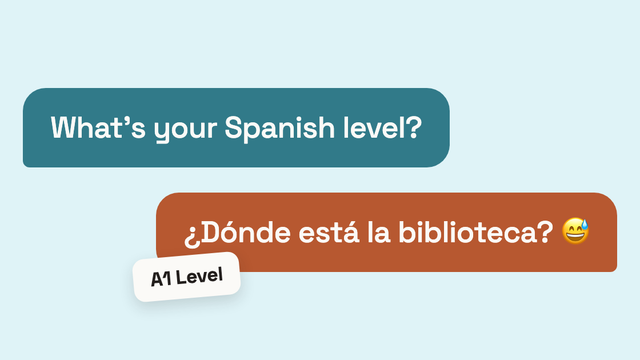
You read Spanish without effort and you follow films. But the moment you have to speak, the words do not come out. That gap is very common.
Two things make the difference: a few ready-made phrases, and real talking time. Here is both, in detail.
The simplest way in: a video call with someone learning your language. That is how PalVivo works, and it is free.
Speak Spanish with a partner, for free
Why the words do not come when it is time to speak
Understanding and speaking use two different skills. The first is passive, the second asks you to produce, fast, with someone watching.
When you listen, your brain recognises the words. When you speak, it has to find them on its own in a couple of seconds. That work only gets trained by speaking.
Then there is the fear of getting it wrong. You hunt for the perfect sentence, you hesitate, and the silence sets in. Fluency comes before perfection. If that block is mostly what you recognise, we go into why you can't speak Spanish separately.
The phrases to have ready when you speak
These act as crutches. They buy you time to think without breaking the rhythm of the exchange.
To buy yourself a few seconds
- “¿Cómo lo diría?”: literally “how would I put this”. You are saying out loud that you are looking for words, which is perfectly natural.
- “Bueno, depende…”: an opener that gives you time to build what comes next.
- “A ver…”: the equivalent of “let me see”, very common in speech.
To give your opinion
- “Para mí…”: to put your point of view without stating it as fact.
- “Si me preguntas…”: more casual, perfect in a relaxed conversation.
- “Yo diría que…”: a flexible turn of phrase that softens the claim.
To hand the turn back
- “¿Y tú?”: the simplest way to hand it back, and the one that lets you breathe.
- “¿Por qué lo dices?”: an informal “how come”, inviting the other person to say more.
- “Cuéntame más.”: you show interest and buy yourself thinking time.
To get out of a blank
- “Se me fue la idea.”: you lost your train of thought; the phrase is common and goes down well.
- “¿Cuál era la palabra?”: asking for the missing word keeps things moving.
- “¿Cómo se dice… en español?”: the question that unblocks just about anything.
Keep five, not fifteen. Say them out loud until they come without thinking.
The exercises that get your speaking moving
A few solo exercises usefully prepare the ground. They do not replace conversation, but they lift part of the block.
1. Talking out loud to yourself
Describe your day in Spanish for two minutes, out loud. It feels silly, but it makes your mouth do the work.
2. Recording yourself and listening back
Record those two minutes and listen. You will spot your hesitations and the words that go missing in the same places every time.
3. Rephrasing what you read
After an article or a video, sum up the idea in three sentences without looking. You move from understanding to producing.
What really gets your speaking off the ground

It clicks when someone answers you. You have to listen, understand and react within the second, with no way to prepare it all.
Then you have to find that person. Private lessons get expensive over time, and chances to speak Spanish around you are rare.
That is why PalVivo exists. You are matched with someone who speaks the language you are learning and is learning yours. You meet once or twice a week.
You take turns: part of the call in their language, part in yours. Nobody pays, since each of you brings what the other is after.
Find your conversation partner, for free
How long before you see a difference
The first sign is not a new word, it is a shorter silence. A few conversations are often enough to notice it.
The real marker comes later: the day you build your sentences without going through English first. That takes several weeks of steady practice, and it tells you far more than vocabulary learnt.
Being regular counts more than the length. Thirty minutes every week is worth more than three hours once a month.
Ready to speak without hunting for words?
The phrases and the exercises are here. What is left is the main thing: talking to someone. Once you get in the habit of practising Spanish out loud every week, the words come faster.
If you are still unsure which format suits you, our rundown of the ways to hold a Spanish conversation online will help you choose.